
Ileana Moro & Marius Ritiu: Two artists, couple and co-founders of studio Allienim.
Ileana Moro approaches painting as a form of introspection, where image becomes a reflection of inner life. Her work unfolds as a visual diary, exploring emotion, existence and the unseen forces that shape the human experience. Guided by intuition, she balances control and surrender, allowing forms to emerge organically. Through light and shadow, her paintings open contemplative spaces that invite a quiet, personal dialogue.
Marius Ritiu moves between sculpture and storytelling, creating open-ended narratives that invite the viewer to complete them in their own mind. His practice explores themes of borders, nationhood and collective identity. Working primarily with copper, he employs an intuitive technique to shape sculptural forms that reflect on connection, movement and shared human experience.
BEFORE THE WORK BEGINS,WHAT GROUNDS YOU BACK TO YOURSELF?
I /
Before I start working, I slow down through silence and solitude. It helps calm my nervous system and return to myself. In those quiet moments I reconnect with the place within, sometimes holding my mother’s necklace.
M /
Before I begin working, I usually need a moment to reconnect with something very simple and physical. There’s a small piece of copper I’ve carried for years. It has no symbolic meaning, but its weight and smoothness anchor me. I hold it, turn it in my hand, feel its temperature shifting.
That tiny gesture resets everything. It pulls me out of whatever noise I’m coming from and into a slower, more intentional frame of mind. It’s a reminder that creation starts with presence, not pressure.

BEFORE THE WORK BEGINS,WHAT GROUNDS YOU BACK TO YOURSELF?
I /
Before I start working, I slow down through silence and solitude. It helps calm my nervous system and return to myself. In those quiet moments I reconnect with the place within, sometimes holding my mother’s necklace.
M /
Before I begin working, I usually need a moment to reconnect with something very simple and physical. There’s a small piece of copper I’ve carried for years. It has no symbolic meaning, but its weight and smoothness anchor me. I hold it, turn it in my hand, feel its temperature shifting.
That tiny gesture resets everything. It pulls me out of whatever noise I’m coming from and into a slower, more intentional frame of mind. It’s a reminder that creation starts with presence, not pressure.

THE DIALOGUE BETWEEN CONTROL AND LETTING GO.
I /
Yes, that tension is very present in my process. I usually begin with control, but there comes a moment when the painting starts to speak. I step back and listen, trying to understand what it asks for. At that point I allow myself to let go and follow the dialogue that emerges.
M /
Very much. Metal is a patient but opinionated companion. You can guide it, shape it, push it toward a certain idea, but it won’t obey blindly. There’s always this push and pull: my intention versus the material’s nature. Early in my career, I tried to dominate the process, but I eventually
learned that the strongest works happen when I allow space for unpredictability. Letting go isn’t about surrendering; it’s about listening. When the material starts suggesting its own direction, I try to follow that thread. That dialogue keeps the work alive.
THE DIALOGUE BETWEEN CONTROL AND LETTING GO.
I /
Yes, that tension is very present in my process. I usually begin with control, but there comes a moment when the painting starts to speak. I step back and listen, trying to understand what it asks for. At that point I allow myself to let go and follow the dialogue that emerges.
M /
Very much. Metal is a patient but opinionated companion. You can guide it, shape it, push it toward a certain idea, but it won’t obey blindly. There’s always this push and pull: my intention versus the material’s nature. Early in my career, I tried to dominate the process, but I eventually
learned that the strongest works happen when I allow space for unpredictability. Letting go isn’t about surrendering; it’s about listening. When the material starts suggesting its own direction, I try to follow that thread. That dialogue keeps the work alive.
WHAT MATERIAL OR PROCESS FEELS LIKE AN EXTENSION OF YOU?
I /
have a love–hate relationship with painting. Sometimes it feels natural, other times very challenging. I’ve never thought about materials in a very technical way, but I’m drawn to the texture of linen when oil paint touches it. The colors begin to shape forms almost on their own, and the process becomes an extension of my subconscious, a way of trying to understand what is happening inside me.
M /
Hammering metal has become almost second nature to me. The repetition of it, the rhythm, the sound, the recoil settles me in a way nothing else does. It’s both physical and reflective. Copper especially feels like an extension of my own temperament. It responds to pressure, heat, oxidation, time; it records every interaction. The way it changes gradually, even after the work is
finished, reminds me that nothing is ever static. I think that’s why I’m drawn to it again and again: it mirrors transformation rather than resisting it.

WHAT MATERIAL OR PROCESS FEELS LIKE AN EXTENSION OF YOU?
I /
have a love–hate relationship with painting. Sometimes it feels natural, other times very challenging. I’ve never thought about materials in a very technical way, but I’m drawn to the texture of linen when oil paint touches it. The colors begin to shape forms almost on their own, and the process becomes an extension of my subconscious, a way of trying to understand what is happening inside me.
M /
Hammering metal has become almost second nature to me. The repetition of it, the rhythm, the sound, the recoil settles me in a way nothing else does. It’s both physical and reflective. Copper especially feels like an extension of my own temperament. It responds to pressure, heat, oxidation, time; it records every interaction. The way it changes gradually, even after the work is
finished, reminds me that nothing is ever static. I think that’s why I’m drawn to it again and again: it mirrors transformation rather than resisting it.

HOW DO YOU SEE OBJECTS AS LIVED WITH, RATHER THAN JUST OBSERVED?
I /
I live quite simply and don’t carry many objects with me. But when I do, it usually holds a special meaning. I wear them during important moments, and they somehow make me feel renewed, like a small ritual.
M /
I find that idea beautiful. When a piece becomes part of someone’s routine something they touch absentmindedly, something that rests against their skin, it gains a second life. It stops being just an object and becomes a witness. The marks, scratches, and patina it accumulates are traces of the person who wears it. For me, that’s the most meaningful fate for a work: to be carried, not just looked at. In a sense, the owner becomes the final collaborator.
HOW DO YOU SEE OBJECTS AS LIVED WITH, RATHER THAN JUST OBSERVED?
I /
I live quite simply and don’t carry many objects with me. But when I do, it usually holds a special meaning. I wear them during important moments, and they somehow make me feel renewed, like a small ritual.
M /
I find that idea beautiful. When a piece becomes part of someone’s routine something they touch absentmindedly, something that rests against their skin, it gains a second life. It stops being just an object and becomes a witness. The marks, scratches, and patina it accumulates are traces of the person who wears it. For me, that’s the most meaningful fate for a work: to be carried, not just looked at. In a sense, the owner becomes the final collaborator.
JEWELLERY CAN BE INTIMATE & EXPRESSIVE. DOES IT REFLECT HOW YOU FEEL?
I /
Yes, I do. I often find myself touching my jewellery when I’m speaking. It gives me a sense of grounding. I have a need to hold or touch something, and jewellery becomes that small anchor for me, almost like a safe space.
M /
I don’t wear a lot, but when I do, it’s usually something with a bit of history or edge to it. At the moment I’m wearing an earring with a cross. It’s small, but it has a grounding effect, like a personal marker. The jewellery I choose is rarely decorative; it’s more like an object that feels right to have with me, depending on where I am mentally or emotionally. Sometimes it’s about identity, sometimes about comfort, sometimes simply about carrying a piece that resonates with the day.

JEWELLERY CAN BE INTIMATE & EXPRESSIVE. DOES IT REFLECT HOW YOU FEEL?
I /
Yes, I do. I often find myself touching my jewellery when I’m speaking. It gives me a sense of grounding. I have a need to hold or touch something, and jewellery becomes that small anchor for me, almost like a safe space.
M /
I don’t wear a lot, but when I do, it’s usually something with a bit of history or edge to it. At the moment I’m wearing an earring with a cross. It’s small, but it has a grounding effect, like a personal marker. The jewellery I choose is rarely decorative; it’s more like an object that feels right to have with me, depending on where I am mentally or emotionally. Sometimes it’s about identity, sometimes about comfort, sometimes simply about carrying a piece that resonates with the day.

WHAT DRAWS YOU TO AN LVK PIECE. FORM, MATERIAL, OR FEELING?
I /
I would choose the EPOC Ring 01 in silver. What attracts me most is the form. It feels like a quiet yet complex minimal object, and I had never seen something like it before. The connection is immediate, more instinct than thought.
M /
I’m drawn to the way Lore balances clarity with softness. Her pieces have strong, deliberate lines, but they never feel cold or distant. There’s always a trace of the hand, a subtle irregularity that makes the metal feel alive. If I were to choose a piece, it would be one that contains that tension: a form that is clean yet carries a quiet emotional charge. I’m interested in objects that feel like they’ve been distilled rather than perfected pieces that hold space for both structure and openness. Lore’s work often sits exactly in that place.
WHAT DRAWS YOU TO AN LVK PIECE. FORM, MATERIAL, OR FEELING?
I /
I would choose the EPOC Ring 01 in silver. What attracts me most is the form. It feels like a quiet yet complex minimal object, and I had never seen something like it before. The connection is immediate, more instinct than thought.
M /
I’m drawn to the way Lore balances clarity with softness. Her pieces have strong, deliberate lines, but they never feel cold or distant. There’s always a trace of the hand, a subtle irregularity that makes the metal feel alive. If I were to choose a piece, it would be one that contains that tension: a form that is clean yet carries a quiet emotional charge. I’m interested in objects that feel like they’ve been distilled rather than perfected pieces that hold space for both structure and openness. Lore’s work often sits exactly in that place.



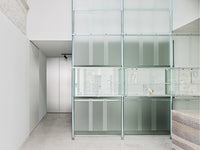
BRUSSELS STORE + ATELIER
De Beauffortstraat 1
1860 Meise
BE0578 912 727
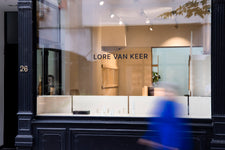
Antwerp Store
Steenhouwersvest 26
Antwerp
